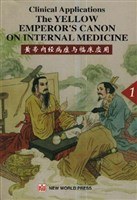
黄帝内经病症与临床应用:英文
【🔥扫码右侧二维码】
【📱扫码极速下载】浏览器自动唤起 💎独家资源·限时共享内容简介:
《黄帝内经》病症与临床应用(外感病证部分),ISBN:9787800054440,作者:王洪图著
目录:
Contents Editor's Note Foreword Introduction: Prmciples, methods and dietary regulation in treating diseases according to The Internal Canon Section one: Treatment Principles Chapter 1: Characteristics ofthe treatment principles included in The Intemal Canon 1. Deciding treatment according to time 2. Deciding treatment according to geographical location 3. Deciding treatment according to individual condition (1) Age and constitution (2) Diet, strain, stress, and spirit Chapter 2: Treatment principles introduced in The Internal Canon 1. Guiding a matter along its course ofdevelopment (1) Conducting treatment according to the location of the pathogens (2) Conducting treatment according to the rise and fall ofthe pathogens 2. Treating diseases by seeking the primary root cause 3. Reinforcing deficiencies and reducing excesses 4. Syndromes ofcold, heat, warm and cool 5. Prevention and early treatment Section two: Treatment Methods Chapter 1: Acupuncture treatments 1. Depth ofneedle insertion and time ofneedle retention 2. Reinforcing and reducing needling techniques (1) Reinforcing and reducing on the basis ofrespiration (2) Reinforcing and reducing by opening and closing the needle punctures (3) Reinforcing and reducing along and against the circulation in the meridian (4) Reinforcing and reducing by Ji-swifl and Xu-slow needle insertion 3. Acupuncture techniques (1) Nine needling techniques (2) Twelve needling techniques (3) Five needling techniques (4) Five variant needling techniques (5) Miuci - contralateral needling (6) Buji Zhuoci - puncturing with needles wrapped in thread 4. Number ofmoxa cones and the reinforcing and reducing achieved by moxibustion (1) Moxa cones and number ofmoxa cones (2) Reinforcing and reducing achieved by moxibustion Chapter 2: Herbal Therapy 1. The Qi-nature, Wei-flavot, and functions ofthe herbs 2. Tropism ofthe five flavors 3. Contra-indication ofthe five tlavors (1) Prohibition against herbal overdose (2) Prohibition ofcertain herbs according to the disease 4. Methods ofselecting herbs (1) Examples ofusing herbs to treat diseases due to six exogenous pathogens (2) Examples ofusing herbs to treat five Zang disorders Chapter 3: Other Therapies 1. An Qiao and Dao Yin therapies 2. Emotional Therapy (1) Using interacted emotions to treat diseases (2) Analyzing the cause ofthe disease (3) Giving verbal advice (4) Other emotional therapies 3. Surgical therapies 4. Binding fingers and traction therapies 5. Additional therapies Section Three: Nursing Care and Regulation Chapter 1: Dietary nursing care and regulation 1. Selection ofthe five food flavors 2. Dietary selection and quantity control 3. Regulation ofcold and hot foods Chapter 2: Regulation ofheat and cold and exercising the limbs Chapter 3: Regulation ofspirit and emotion SectionFour: Clinical Applications: TheExog- enous Diseases and Syndromes Chapter 4: Wind Diseases and Syndromes 1. Pathogenic Wind on Superficial Parts ofthe Body (1) Aversion to Wind (2) Aversion to Wind with Sweating (3) Aversion to Wind with Sweating and Headache (4) Chills and Shivering with Headache and Heaviness in the Body, but No Sweating 2. Pathogenic Wind on Meridians (1) Pathogenic Wind on Taiyang Meridian (2) Pathogenic Wind on Yangming Meridian 3. Pathogenic Wind on the Exterior and Interior of the Body (1) Wind Reverse Syndrome (2) Exterior and Interior Excess Syndromes 4. Pathogenic Wind on Acupuncture Points (1) Alcohol Wind (2) Brain Wind Syndrome (3) Head Wind (4) Intemal Wind 5. Pathogenic Wind on Zang Fu Organs (1) Stomach Wind Syndrome (2) Intestine Wind Syndrome (3) Liver Wind (4) Heart Wind (5) Spleen Wind (6) Lung Wind (7) Kidney Wind (Including Acute Nephritis) 6. Other Wind Diseases (1) Pestilence Wind (Including Leprosy) (2) Tiredness Wind Syndrome (Including Bronchiectasis and Pulmonary Abscess) (3) Latent Urticaria (Including Urticaria and Psoriasis) Chapter 2: Cold Diseases and Syndromes 1. Pathogenic Cold on the Exterior ofthe Body (1) The Syndrome Manifested by Chills, Anhydrosis, No Fever, Abdominal Distention, Stuffiness and Agitation (2) The Syndrome Manifested by Fever, Chills, Anhydrosis Asthmatic Breathing and Superficial, Tense Pulse (3) The Syndrome Manifested by Fever, Chills, Anhydrosis, Coughing or Asthmatic Breathing, Retching, Diarrhea, Dysuria, Fullness in the Lower Abdomen, and Discomfort ofthe Throat or Thirst 2. Impairment ofthe Exterior and Interior by Pathogenic Factors (1) The Syndrome Induced by Cold Combined with Damp (2) Pathogenic Cold Combined with Wind Attacking the Exterior or Interior ofthe Body 3. Cold Impairing the Four Limbs and Brain (1) Cold Attacking the Four Extremities(Including Raynaud's Syndrome) (2) Cold Attacking the Brain Causing Headaches(Including Angioneurotic Headaches) 4. Pathogenic Cold Injury to the Zang Fu Organs (1) Cold Attacking the Lungs (2) Cold Attacking the Spleen (3) Cold Attacking the Kidneys (4) Cold Attacking the Liver (5) Cold Attacking the Stomach Chapter 3: Summer Heat Diseases and Syndromes 1. Summer Heat in Combination with Cold (1) The Attack of Summer-heat in Combination with Cold (2) The Attack ofSummer-heat and Cold Extemally and Intemal Damp Retention Syndrome 2. Sununer Heat in Combination with Damp (1) Syndrome Manifested by Fever, Sweating, Thirst and Heaviness ofthe Body (2) Syndrome Manifested by Headache, Restlessness Thirst, Abdominal Pain, Vomiting, Diarrhea, and Dysuria with a Deep-Yellow Complexion 3. Summer Heat Extemally with Interior Heat 4. Summer Heat on Lungs 5. Summer Heat on Yangming Meridian 6. Summer Heat Injury to Qi and Yin 7. Summer Heat on Heart Section Five: Dampness Diseases and Syndromes Chapter 1: Damp Pathogen on the Surface ofthe Body 1. Common Cold Due to Dampness 2. Common Cold Due to Mildew and Dampness 3. Damp Pathogen on Superior ofBody 4. Acne and Miliaria Chapter 2: Damp Pathogen on Limbs and Meridians 1. Damp Bi Syndromes (1) Simple Damp Bi Syndrome (2) Dampness and Cold Bi Syndrome (3) Dampness and Heat Bi Syndrome 2. Constriction, Spasm, Atrophy and Weakness 3. Kidney Bi Syndrome 4. Damp Pathogen on Extenor and intenor 5. Jaundice Chapter 3: Damp Pathogen on the Sanjiao Zang Fu Organs 1. Retention ofDampness in Middle Energizer 2. Retention ofDampness in Triple Energizer 3. Damp Pathogen on Lungs 4. Damp Pathogen on the Spleen (1) Treating by driving out water (2) Combination ofreinforcing and reducing treatment 5. Damp Pathogen on the Kidney 6. Damp Pathogen on the Spleen and Kidney 7. Damp Pathogen on the Large Intestine Section Six: Dryness Diseases and Syndromes Chapter 1: Dryness induced exterior syndromes 1. Cold-dryness induced exterior syndrome 2. Wann-dryness induced exterior syndrome Chapter 2: Dryness impairing the configuration and orifices 1. Diyness impairing the skin 2. Dryness impairing the orifices 3. Dryness impairmg the tendons and meridians (1) Dryness and fire impairing the Qi system (2) Dryness impairing the Ym blood Chapter 3: Dryness damaging the lungs 1. Dry-heat injuring the lungs 2. Dryness with phlegm Chapter 4: Dryness impairing the stomach and intestines 1. Dry-heat damaging the stomach 2. Dryness in the intestines with constipation Chapter 5: Dryness impairing the liver Chapter 6: Dryness impairing the kidneys Section Seven: Fire and Heat Syndromes Chapter 1: Points manipulated to treat heat syndromes 1. Fifty-nine points from Plain Questions and their appllication (1) Twenty-five points used to expel heat from Yang meridians (2) Eight points for clearing heat from the chest (as the four points below are bilateral, they total eight actual manipulation points) (3) Eight points for clearing heat from the stomach (as the four points below are bilateral, they total eight actual manipulation points) (4) Eight points for clearing heat from the four limbs (as the four points below are bilateral, they total eight actual manipulation points) (5) Ten points for clearing heat from the Five Zang Organs (as the five points below are bilateral, they total ten actual manipulation points) 2. Fifty-nine points from Miraculous Pivot: Heat Syndromes (1) Twenty-eight points on hand and foot (2) Thirty-one points on the head, face and neck Chapter 2: Treatment is given by differentiating heat in six meridians 1. Heat in Taiyang 2. Heat in Yangming 3. Heat in Shaoyang 4. Heat in Taiyin 5. Heat in Shaoyin 6. Heat in Jueyin Chapter 3: Treatment offebrile diseases according to initial symptoms 1. Skin pain, stuffy nose, small rashes appearing on the nose and puffiness ofthe face. 2. Pain in the chest and hypochondrium and restlessness of the hands and feet 3. Pain in arms 4. Headache and distention ofthe head 5. Pain in the lower leg and foot 6. Heavy sensation ofthe body, bone pain, deafness, drowsiness 7. Dizziness and fullness ofthe chest and hypochondrium 8. Diet in treating febrile diseases Chapter 4: Treatment offebrile diseases according to the pulse 1. Febrile diseases after 3 days with the Cunkou pulse calm and the Renying pulse restless 2. Febrile diseases after 7 or 8 days with the Cunkou pulse is rapid and asthmatic breathing Chapter 5: Treatment according to the primary associated symptoms 1. Stiflhess and discomfort ofthe body, irritability, dry throat and dry lips 2. Headache, bluish complexion, restlessness ofhands and feet, or inability to walk due to flaccidity oflower limbs, profuse tears 3. Reoccurring epilepsy, convulsions ofhands and feet, manic behavior, or hair loss 4. Headache, twltching and pain ofthe temple region and around the eyes, and epistaxis 5. Heaviness ofthe body and heat in the intestines 6. Spasm and pain around the umbilicus, fullness ofthe chest and distention ofthe hypochondrium Chapter 6: Differentiation and treatment ofthe febrile diseases ofthe five intemal organs 1. Heat induced liver diseases 2. Heat induced heart disorders 3. Heat-induced spleen disorders 4. Heat induced lung disorders 5. Heat induced kidney disorders Chapter 7: Heat induced Six Fu Organ disorders and the syndrome ofheat entering the uterus 1. Heat induced gallbladder disorder 2. Heat induced stomach disorder 3. Heat induced disorder ofthe small intestine 4. Heat induced disorder ofthe large intestine 5. Heat induced triple energizer disorder 6. Heat induced bladder disorder 7. Heat on the uterus (the chamber ofblood) Appendix One: Simple Formulas for Febrile Diseases Epilogue Index ofAcupuncture Point Illustrations by Groupings Index ofAcupuncture Point Illustrations by Alphabetical Order Text in Chinese


评论