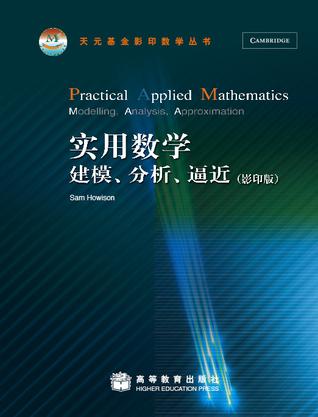
实用数学(影印版)
【🔥扫码右侧二维码】
【📱扫码极速下载】浏览器自动唤起 💎独家资源·限时共享内容简介:
本书内容分为三部分:建模,讲述了建模的一些原则(包括物理定律、本构关系及守恒定律),量纲分析(包括Buckingham的Pi定理)等;分析技巧,讲述了偏微分方程和广义函数的基础知识;渐近分析,讲述了渐近展开的基本概念,正则摄动展开,边界层和多重尺度法等。 目录 Preface Part Ⅰ Modelling techniques 1 The basics of modelling 1.1 Introduction 1.2 What do we mean by a model? 1.3 Principles of modelling: physical laws and constitutive relations 1.4 Conservation laws 1.5 General remarks 1.6 Exercises 2 Units, dimensions and dimensional analysis 2.1 Introduction 2.2 Units and dimensions 2.3 Electric fields and electrostatics 2.4 Sources and further reading 2.5 Exercises 3 Nondimensionalisation 3.1 Nondimensionalisation and dimensionless parameters 3.2 The Navier-Stokes equations and Reynolds numbers 3.3 Buckingham's Pi-theorem 3.4 Sources and further reading 3.5 Exercises 4 Case studies: hair modelling and cable laying 4.1 The Euler-Bernoulli model for a beam 4.2 Hair modelling 4.3 Undersea cable laying 4.4 Modelling and analysis 4.5 Sources and further reading 4.6 Exercise 5 Case study: the thermistor (1) 5.1 Heat and current flow in thermistors 5.2 Nondimensionalisation 5.3 A thermistor in a circuit 5.4 Sources and further reading 5.5 Exercises 6 Case study: electrostatic painting 6.1 Electrostatic painting 6.2 Field equations 6.3 Boundary conditions 6.4 Nondimensionalisation 6.5 Sources and further reading 6.6 Exercises Part Ⅱ Analytical techniques 7 Partial differential equations 7.1 First-order quasilinear partial differential equations: theory 7.2 Example: Poisson processes 7.3 Shocks 7.4 Fully nonlinear equations: Charpit's method 7.5 Second-order linear equations in two variables 7.6 Further reading 7.7 Exercises 8 Case study: traffic modelling 8.1 Simple models for traffic flow 8.2 Traffic jams and other discontinuous solutions 8.3 More sophisticated models 8.4 Sources and further reading 8.5 Exercises 9 The delta function and other distributions 9.1 Introduction 9.2 A point force on a stretched string; impulses 9.3 Informal definition of the delta and Heaviside functions 9.4 Examples 9.5 Balancing singularities 9.6 Green's functions 9.7 Sources and further reading 9.8 Exercises 10 Theory of distributions 10.1 Test functions 10.2 The action of a test function 10.3 Definition of a distribution 10.4 Further properties of distributions 10.5 The derivative of a distribution 10.6 Extensions of the theory of distributions 10.7 Sources and further reading 10.8 Exercises 11 Case study: the pantograph 11.1 What is a pantograph? 11.2 The model 11.3 Impulsive attachment for an undamped pantograph 11.4 Solution near a support 11.5 Solution for a whole span 11.6 Sources and further reading 11.7 Exercises Part Ⅲ Asymptotic techniques 12 Asymptotic expansions 12.1 Introduction 12.2 Order notation 12.3 Convergence and divergence 12.4 Further reading 12.5 Exercises 13 Regular perturbation expansions 13.1 Introduction 13.2 Example: stability of a spacecraft in orbit 13.3 Linear stability 13.4 Example: the pendulum 13.5 Small perturbations of a boundary 13.6 Caveat expandator 13.7 Exercises 14 Case study: electrostatic painting (2) 14.1 Small parameters in the electropaint model 14.2 Exercises 15 Case study: piano tuning 15.1 The notes of a piano: the tonal system of Western music 15.2 Tuning an ideal piano 15.3 A real piano 15.4 Sources and further reading 15.5 Exercises 16 Boundary layers 16.1 Introduction 16.2 Functions with boundary layers; matching 16.3 Examples from ordinary differential equations 16.4 Case study: cable laying 16.5 Examples for partial differential equations 16.6 Exercises 17 Case study: the thermistor (2) 17.1 Strongly temperature-dependent conductivity 17.2 Exercises 18 Lubrication theory' analysis in long thin domains 18.1 Lubrication theory' approximations: slender geometries 18.2 Heat flow in a bar of variable cross-section 18.3 Heat flow in a long thin domain with cooling 18.4 Advection-diffusion in a long thin domain 18.5 Exercises 19 Case study: continuous casting of steel 19.1 Continuous casting of steel 19.2 Exercises 20 Lubrication theory for fluids 20.1 Thin fluid layers: classical lubrication theory 20.2 Thin viscous fluid sheets on solid substrates 20.3 Thin fluid sheets and fibres 20.4 Further reading 20.5 Exercises 21 Case study: turning of eggs during incubation 21.1 Incubating eggs 21.2 Modelling 21.3 Exercises 22 Multiple scales and other methods for nonlinear oscillators 22.1 The Poincare-Linstedt method 22.2 The method of multiple scales 22.3 Relaxation oscillations 22.4 Exercises 23 Ray theory and the WKB method 23.1 Introduction 23.2 Classical WKB theory 23.3 Geometric optics and ray theory: why do we say light travels in straight lines? 23.4 Kelvin's ship waves 23.5 Exercises References Index
目录:
PrefacePart Ⅰ Modelling techniques1 The basics of modelling1.1 Introduction1.2 What do we mean by a model?1.3 Principles of modelling: physical laws and constitutive relations1.4 Conservation laws1.5 General remarks1.6 Exercises2 Units, dimensions and dimensional analysis2.1 Introduction2.2 Units and dimensions2.3 Electric fields and electrostatics2.4 Sources and further reading2.5 Exercises3 Nondimensionalisation3.1 Nondimensionalisation and dimensionless parameters3.2 The Navier-Stokes equations and Reynolds numbers3.3 Buckingham's Pi-theorem3.4 Sources and further reading3.5 Exercises4 Case studies: hair modelling and cable laying4.1 The Euler-Bernoulli model for a beam4.2 Hair modelling4.3 Undersea cable laying4.4 Modelling and analysis4.5 Sources and further reading4.6 Exercise5 Case study: the thermistor (1)5.1 Heat and current flow in thermistors5.2 Nondimensionalisation5.3 A thermistor in a circuit5.4 Sources and further reading5.5 Exercises6 Case study: electrostatic painting6.1 Electrostatic painting6.2 Field equations6.3 Boundary conditions6.4 Nondimensionalisation6.5 Sources and further reading6.6 ExercisesPart Ⅱ Analytical techniques7 Partial differential equations7.1 First-order quasilinear partial differential equations: theory7.2 Example: Poisson processes7.3 Shocks7.4 Fully nonlinear equations: Charpit's method7.5 Second-order linear equations in two variables7.6 Further reading7.7 Exercises8 Case study: traffic modelling8.1 Simple models for traffic flow8.2 Traffic jams and other discontinuous solutions8.3 More sophisticated models8.4 Sources and further reading8.5 Exercises9 The delta function and other distributions9.1 Introduction9.2 A point force on a stretched string; impulses9.3 Informal definition of the delta and Heaviside functions9.4 Examples9.5 Balancing singularities9.6 Green's functions9.7 Sources and further reading9.8 Exercises10 Theory of distributions10.1 Test functions10.2 The action of a test function10.3 Definition of a distribution10.4 Further properties of distributions10.5 The derivative of a distribution10.6 Extensions of the theory of distributions10.7 Sources and further reading10.8 Exercises11 Case study: the pantograph11.1 What is a pantograph?11.2 The model11.3 Impulsive attachment for an undamped pantograph11.4 Solution near a support11.5 Solution for a whole span11.6 Sources and further reading11.7 ExercisesPart Ⅲ Asymptotic techniques12 Asymptotic expansions12.1 Introduction12.2 Order notation12.3 Convergence and divergence12.4 Further reading12.5 Exercises13 Regular perturbation expansions13.1 Introduction13.2 Example: stability of a spacecraft in orbit13.3 Linear stability13.4 Example: the pendulum13.5 Small perturbations of a boundary13.6 Caveat expandator13.7 Exercises14 Case study: electrostatic painting (2)14.1 Small parameters in the electropaint model14.2 Exercises15 Case study: piano tuning15.1 The notes of a piano: the tonal system of Western music15.2 Tuning an ideal piano15.3 A real piano15.4 Sources and further reading15.5 Exercises16 Boundary layers16.1 Introduction16.2 Functions with boundary layers; matching16.3 Examples from ordinary differential equations16.4 Case study: cable laying16.5 Examples for partial differential equations16.6 Exercises17 Case study: the thermistor (2)17.1 Strongly temperature-dependent conductivity17.2 Exercises18 Lubrication theory' analysis in long thin domains18.1 Lubrication theory' approximations: slender geometries18.2 Heat flow in a bar of variable cross-section18.3 Heat flow in a long thin domain with cooling18.4 Advection-diffusion in a long thin domain18.5 Exercises19 Case study: continuous casting of steel19.1 Continuous casting of steel19.2 Exercises20 Lubrication theory for fluids20.1 Thin fluid layers: classical lubrication theory20.2 Thin viscous fluid sheets on solid substrates20.3 Thin fluid sheets and fibres20.4 Further reading20.5 Exercises21 Case study: turning of eggs during incubation21.1 Incubating eggs21.2 Modelling21.3 Exercises22 Multiple scales and other methods for nonlinear oscillators22.1 The Poincare-Linstedt method22.2 The method of multiple scales22.3 Relaxation oscillations22.4 Exercises23 Ray theory and the WKB method23.1 Introduction23.2 Classical WKB theory23.3 Geometric optics and ray theory: why do we say light travels in straight lines?23.4 Kelvin's ship waves23.5 ExercisesReferencesIndex


评论